All posts by Sandy James

Featured image for “Where is the Equity for Sidewalk Users in Metro Vancouver?”

It’s time to take a look at what is happening for walkers and rollers in Metro Vancouver and the news is not good. The City of Vancouver tries the salvo of comparing the number of pedestrian deaths to other major cities in the world which is not really relevant.

In the City of Vancouver there is no major freeway with off ramps through the city  and not many  places where people can legally travel over 50 kilometers an hour on streets, so any comparison to another major international city with such infrastructure is apples and oranges.  But it shows that instead of seriously looking at curb ramp infill and enhancing the walking and rolling environment the City chooses to change the subject.

Metro Vancouver municipalities need to see the enhancement of sidewalks and the walking and rolling environment as vitally important. Curb ramp infill at every corner needs to be done, and should not be delayed for budgetary reasons.

Vehicle driver speed is responsible for one third of all crashes, and implementing slower speeds allows for higher pedestrian survival rates. If 90 percent of pedestrians can survive a  vehicle driver crash at 30 km/h and if only 10 percent of pedestrians can survive a vehicle driver crash at 50 km/h, why not implement that survivable speed, as they have done in countless cities in Europe? Why is it in a province that champions universal health care is the ability to implement 30 km/h speeds in municipalities NOT the top priority of the provincial government?

A simple glance in the Coroners’ Service Statistics for 2021 show that despite the pandemic and the fact supposedly less people were driving, 56 pedestrians died in the Province.  In comparison in  pandemic 2020 there were 35 pedestrians killed.

During the pandemic municipalities encouraged walking and cycling, and in the case of Vancouver implemented Slow Streets as a measure to provide more room for walking and rolling. Given the estimates that 30 to 40 percent of people are still doing some work from home or changing their daily commute, the fact that the number of pedestrians being killed has dramatically risen shows that more needs to be done for pedestrian infrastructure.

In 2022 to date seven pedestrians have died. That is seven people who won’t get home to their families.

In 2021 ten pedestrians died, four while walking or rolling on Vancouver sidewalks.

Figures from March 2019 show that Canada has a rate of 5.8 road deaths per 100,000 people. We can look at the United States with their extensive road networks and a death rate of 12.4 per 100,000.

But that’s not where we should be comparing. Best practices are in Europe, which is bringing in vehicle speed regulators,  has championed slower speeds , implemented country wide speed cameras and just become serious at implementing Vision Zero, ensuring that no road deaths happen.

Our rate of death in Canada is double that of the United Kingdom at 2.9 and of Switzerland which is 2.2 .

And pedestrians in Canada are more likely to die than vehicle passengers or motorcyclists in a vehicle driver crash.

Statistics Canada shows that in 2020, 50 percent of all road deaths were drivers, 15 percent were passengers, 15.2 percent were pedestrians, 13.9 percent were motorcyclists and 2.7 percent were cyclists.

In British Columbia between 2012 and 2021 55 people a year have died by driver crashes while walking or rolling.

Most of those dead were men at 58 percent of fatalities, and 60 percent of all deaths are people over the age of 50 years. Fraser Health Unit (which includes Delta, Surrey and Burnaby) had 207 people die in this nine year period, while Vancouver Coastal Health had 127 people die. In terms of cities, Vancouver had the highest number of deaths at 87, with Surrey the second highest at 77 lives lost.

While it is now proven that walking and mobility are vital for sociability, engagement, and continued physical and mental health, the City of Vancouver has ignored this most important part of micromobility.

A new study also shows that even light walking after a meal improves health and blood sugar levels  and enhancing walkable infrastructure keeps citizens of all ages mobile. Sidewalk and walking infrastructure keeps citizens healthy.

In a city that is worried about providing adequate park space in the Broadway Plan and in a Metro Vancouver area that is now fretting about parks being at capacity it simply makes sense to expand the lessons learned on the city’s greenways network which championed walking.  

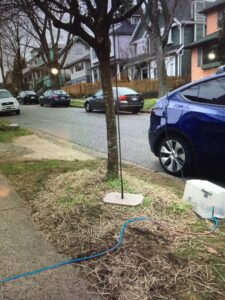
We need to  offer all age accessibility on every walking and rolling environment and sidewalk in Vancouver. That also means a rethink of Vancouver Council’s  “vehicles first” policy which allows for personal  Electric Vehicle cord charging conduits to be placed across sidewalks.

One more example where sidewalk users, undoubtedly the most sustainable mode of transportation are relegated to being second class citizens to electric vehicles. Where is the equity?
Accessible sidewalks, safe intersections, the use of raised crosswalks have all been done in Vancouver. The raised crosswalk brings walkers and rollers to the same level of vehicles, and means there is no grade change from the sidewalk. Other than a few examples, the city has ignored implementing this as a programmed element in street changes or major development.

The City of Vancouver’s own numbers show why the walking environment needs to be enhanced now: 45 percent of pedestrian fatalities are seniors, and 50 percent of all pedestrian fatalities and serious injuries happen at night. Half of all the vehicle driver crashes in the city that are fatal or life changing injuries involve pedestrians and cyclists. And most of those vehicle driver crashes occur in Vancouver’s low light and rainy winters, meaning that walking infrastructure and lighting should be enhanced  and posted vehicle driver speed decreased.

In a province where nearly 80 percent of all driver crashes with pedestrians occur at intersections it just makes sense to improve the walking and rolling infrastructure, slow vehicle driver traffic down, and save people from serious injury and avoidable death in municipalities.

Why is wellbeing and mobility of residents at this micromobility and  sustainable level not a priority?

Featured image for “Can You Sue The City Over Snow? Supreme Court and BC Court of Appeals Plow Through”

January 18, 2022

Can You Sue The City Over Snow? Supreme Court and BC Court of Appeals Plow Through the Issues

Written by:Sandy James Planner

Two recent court decisions inform how cities will be handling snow removal on sidewalks.

In a ruling that came down in October the Supreme Court of Canada ordered a new trial for Taryn Joy Marchi who hurt her leg climbing over a snowbank in Nelson B.C.

In court the City of Nelson argued that snow removal was immune from negligence claims because it was a “core policy decision”. The Supreme Court of Canada had to decide whether snow removal was a “core policy decision” (which makes the municipality not answerable to negligence or liability claims, or whether it was an  “operational decision”  taking while undertaking city policy, which is open to liability claims.

Ms. Marchi had traversed over snow from angled city parking on the street to a city sidewalk. There was no way to access the sidewalk except through a snowbank. Ms. Marchi successfully argued that providing an access in snow from the city parking lot to the sidewalk was not a “core policy  decision” but was an “operational decision” taken by the City of Nelson. You can read more about this case here.

This of course has ramifications for other Canadian municipalities. The Supreme Court found that  angled parking spaces would not have been cleared if it was not intended for residents to use them, and had a pathway in the snow been cleared in a path from the parking to the sidewalk Ms. Marchi would not have injured her leg. A new trial has been ordered.

Another trial again in British Columbia examined whether residents are liable for clearing the snow in front of their houses. As Jason Proctor notes in this CBC report, Canadians have been suing each other for decades about sidewalk snow removal in front of their houses and slips and falls.

In 2017 Darwin Der slipped and fell on black ice on the sidewalk in Burnaby. His case went to the B.C. Court of Appeal with a lawsuit against the couple who owned the adjacent house, arguing that the property owners owed a “general duty of care to remove snow and ice from their section of the sidewalk.”

The court of appeal judges disagreed, saying those residential property owners had shovelled the sidewalk the previous day and had salted it that day. They had done their civic duty and that “The snow and ice accumulating on public sidewalks and the potholes on the street in front of the house are the legal responsibility of the municipality, not the adjacent property owner.”

So at this point all eyes are back on those municipalities.

The new trial in Ms. Marchi’s case will establish whether it is policy or an operational decision when  Nelson plows the on street parking out, but forgets to provide a pathway through the snow  onto the sidewalk; and as it stands, if you do the basic shovelling on your sidewalk in front of your house, any ice or potholes contributing to falls are the city’s fault.

Featured image for “Want to Boost Your Well-Being & Mental Health? Go For a Walk in the Woods Now”

Want to Boost Your Well-Being & Mental Health? Go For a Walk in the Woods Now

Want to feel better about yourself quickly? Get out into a forest for a walk.

It has been known for a while that getting out in nature boosts mental and physical health, but no one has quantified what that value was to health care systems. A study done by Forest Research in the United  Kingdom was the first to come up with some monetary figures.

Going for a walk in nature means “fewer doctor visits and prescription, reduced hospital and social service care, and reduced lost days of work”.  The Japanese refer to this as “forest bathing”.

And here’s something very interesting: the study showed that street trees in urban places “cut an additional 16 million pounds (24.4 in Canadian dollars)  from antidepressant costs”.

Damian Carrington in The Guardian notes that while the pandemic has increased mental illness, “green prescribing” getting people to go for a walk in nature helps. In the survey work done by Forest Research,  “90 percent of respondents said woodlands were important to them in reducing stress”.

You can take a look at the actual study with principal researcher Vadim Saraev here.

The information is clear: if people spend just thirty minutes a week in a forest grove, they feel better. And the data proves it: the annual mental health benefits of visiting woodlands and forest groves are estimated to be 185 million pounds or 317.5 million Canadian dollars.

That means this research makes the case for continued investment in forests and city treescapes for mental and physical well-being, not only for sustainability, shade and mitigating climate change.

The research also shows that you don’t particularly need to do anything in the forest, that walking and sitting is just as good. As Dr. William Bird has previously said, looking at a cellphone screen does not count, your field of vision and senses need to be taken up by the woodland.

There was also a study in Australia where visits to green spaces of at least thirty minutes lowered depression rates by seven percent.  You can take a look at this study from Brisbane in 2020 here, that concluded the need for green space during the pandemic was vital for well-being.

Another British study showed that a two hour visit in nature weekly significantly increased “wellbeing”.  This was the first study to ascertain how much time was needed to be in nature to get an effect, and predicted that in the future “two hours in nature could join five a day of fruit and vegetables and 150 minutes of exercise a week as official health advice.

Access to these wooded areas and forests needs to be more easier: in England only 63 percent of people visit the woods once a year. That number increases to 80 percent in Scotland, Wales and Northern Ireland. Of those people that visit the woods several times a month,  half of those people are in Scotland.

Some of that advice about walking in the wods for mental health already seems to be followed in Metro Vancouver.  Neal Carley, General Manager of Parks, Planning and the Environment for Metro Vancouver states that the regional parks have been  discovered and heavily used during the pandemic. With a normal visitor volume of 12 million visits annually,  Metro Vancouver parks had  16.5 million visits in 2020 and 17 million visits in 2021.

Here’s a quick virtual walk in the woods below. Please note this video does not substitute for your own walk and time in a local forest.

Top image:Town&Country

Does your Public Space Pass the Seven Year Test?

It was Chris Foxon, a former groundskeeper for the Vancouver School Board that noted that publics change, and that in every seven years there was a new cohort of people that are using public spaces. Mr. Foxon saw the effective use of space as having a seven year life span before those space need to be re-evaluated or repurposed for changing people and interests.

The Tupper Neighbourhood Greenway has been one of the city’s most constant and neighbourhood loved spaces located to the north of Tupper Secondary School in the 400 block of East 23rd Avenue.

The street on this block had been originally closed in the 1970’s due to street racing, and had been left as a closed asphalt surface with two chains on either street end. One side was playing fields associated with the school; the other side was the physical campus of the school. That closed street stayed that way for over thirty years.

In 2003 a student at Tupper Secondary, Jomar Lanot went to play basketball with friends on the school grounds on a weekend. Leaving the grounds he was accosted by a gang not related to the school. He was murdered.

In the aftermath of this tragedy the neighbourhood wanted to do something to commemorate this tragedy, and  to bring the community together after such a horrendous event. Walking with community members and teachers, formalizing this closed street into a public space that could be used by residents and the school seemed like the right thing to do.

You can look at the report to Council on this neighbourhood greenway here.

The design for this closed street was developed in concert with school students, who actually led some of the public process. The city’s engineer on the project, Linda Chow, had been a graduate of Tupper Secondary. Over several months the design was collaborated upon, and featured two infiltration gardens at each end of the street, a small amphitheatre of boulders for class teaching and a commemorative boulder in the centre.

The benches that are surrounding the boulder were designed by the shop class at the school, and were fabricated there.

In the City of Vancouver you cannot commemorate people on city streets, so Jomar’s name could not be put on the rock. But what could be placed was a quote. The school student body was given a choice of several quotes that could be engraved on the rock, and they chose a quote which came from Jomar’s school notebooks:

“Culture is the root of our lives and Love is the most powerful force”.

The engraving on the rock was done onsite so that the students could witness that  part of the process.
When this neighbourhood greenway was planted, the school and community came out to do the work, while the culinary program at the school provided the cuisine. The VanDusen Master Gardeners followed up doing garden replanting, weeding and maintenance and had an active committee that stewarded the garden. The Lanot family was involved in the planting and the maintenance of the space, and Jomar’s mother spoke at the opening of the greenway.

The students at Tupper Secondary won the Mayor’s Award for Youth Involvement for their participation in the project in 2008.

This is a space that is always used. There is a violincello player that comes in the early afternoons to practice. Children and adults use the space, and there is a bikeway path that goes through the space. The garden portions of the greenway are well maintained and cared for.

These photos show how the gardens look today, with some maintenance being done on the infiltration gardens. The concept and space are now approaching 14 years of being actively used and maintained, although the original story of who Jomar was and how he died has been lost to many newcomers in the area. But the intent of the space, to bring community together carries on.

It is one of the most successful ongoing community spaces in east Vancouver, and illustrates the power of legacy when it is the right idea at the right time: inclusive open space for both students and residents.

Why We Like Big Things in Public Art

In a conversation with a well known local journalist, I asked her to name the number of statues she knows that are of women in Canada. Together we could only think of three or four in the whole country.

The Canadian Women’s Foundation has a list of statues and monuments to women and mention four statues nationally.  I would add in a fifth statue to the list, the Emily Carr statue in Victoria.

A statue is described as a “free-standing sculpture” where a realistic life size person or animal is depicted either by carving or by cast. They have been around for millennia, and one is often the first object taught in university art history classes.

In Roman times, having a statue of yourself depicted great status, and having a public statue of yourself showed you were effective in politics or business. In the 20th century many statues are built to commemorate important events and figures. It was not until the 1920’s and 1930’s that statues started to have more abstract forms. Henry Moore was one of the  British artists that brought abstract art into mainstream acceptance.

In Brockville Ontario a sculpture on Blockhouse Island  attracts young children to it, mainly girls. It is this one below, and it would be a sixth entry to the Canadian list of statues about women.

The scale of it is close to human size, and approachable. It is also local design, being the creation of secondary school students at the Thousand Islands Secondary School.

Installed in a  2011 ceremony called the  “Voices of Hope” it is a tribute to women who experience violence and to the people who work to stop it. It is a difficult subject and sometimes a taboo topic, but is approachable and accessible, with the two figures holding birds aloft. It is described as a “symbol of hope for a violence free community”.

There is little written in the newspapers about this statue, but the fact it exists brings forward a topic that should be centred, and allows for the contemplation of the topic in a park environment.

Today, November 25 is also the United Nations designated day for the Elimination of Violence against Women. There is a monument in Thornton Park called the Marker of Change recognizing the 14 women killed at the Ecole Polytechnique in Montreal, but it is not figurative. It contains a series of 14 pink granite benches recognizing the 14 lives.

While there is much discussion about statues that need contextual interpretation to be relevant, there are others that probably should be put away in a museum or gallery that can explore why it was appropriate for the time, and what cultural reference it has for social mores of its era. An example is the 70 year old  Theodore  Roosevelt statue which is politely called “troubling” . The statue is being removed from its location in front of the Museum of Natural History in New York and shipped to North Dakota.

Vancouver itself is not without controversy about statues. One example is the Terry Fox Monument that was constructed in 1984 near BC Place.   Vancouver Sun’s Jeff Lee  describes it this way “I’ve yet to find more than a handful of people who appreciate the architectural folly with its glass fibre lions and unworking projection screen atop a fat arch. Most people have a visceral reaction, still hating the Franklin Allen-designed monument. After 27 years, the pink stucco-style faux Beaux-Artes memorial still evokes a negative reaction from many.”

The post-modernist monument designed by Franklin Allen was selected by a committee headed up by Architect Arthur Erickson. The monument is very 1980’s, with its very shell pink exterior and neoclassical design.

No one really knew what it was or who it represented.  This YouTube video below has some typical responses.

It was demolished and replaced in 2011 by a more figurative sculpture of Terry Fox designed  by artist and author Douglas Coupland.

And it’s the Coupland work on that spot today.You can see the YouTube video below unveiling Douglas Coupland’s Terry Fox sculpture with former Premiere Christy Clark doing the honours.

images: VancouverSun & sandyjames

The Danger Months of Vancouver For Pedestrians

Winter are the danger months for pedestrians in this Province. Almost double the number of pedestrians are seriously injured in vehicle crashes between October and January when compared to the four month period between May and August.

In the entire province almost one third of all pedestrian deaths happen in Vancouver and Surrey, with nearly 60 percent of those deaths being males. In the last nine years 151 pedestrians have been killed in just those two municipalities.

Metro Vancouver is unique in having dark, wet winter days and evenings without the reflectivity of snow. Add in trees and rain and it is difficult for vulnerable road users, those without a steel vehicle frame to protect them, to be seen by vehicle drivers.

But there is a new wrinkle in Vancouver this year and it is worthy of note. To date ten pedestrians have been killed in the City of Vancouver. But four of those victims, or 40 percent were killed while they were on sidewalks.

That sobering horrible statistic suggests that wearing bright clothes or reflection does not help when vehicle drivers are out of control and crash their cars into people on sidewalks. There were two students killed walking on a sidewalk at University of British Columbia.  A vehicle crashed into a father carrying his two year old daughter in July. (There is a Go Fund Me campaign for the parents, who both witnessed the death). And in November  a man in a wheelchair was killed when a  vehicle driver lost control and crashed into him on a Davie Street sidewalk.

Kudos to the Vancouver Sun for producing a responsible video that outlines the statistics about pedestrian serious injuries and fatalities and do not once mention wearing reflectivity. That video is posted below.

In partnership with police departments, ICBC (Insurance Corporation of British Columbia) records  sixty different contributing factors to pedestrian fatalities across the province, and you can view that graph here.  In the last four years  driver speed, driver distraction, and driver being impaired were the top three factors resulting in pedestrian deaths.

We need to address driver road speed, driver distraction, driver  impairment and road design.

All of these factors are out of the pedestrians’ control.

Slowing driver road speeds in municipalities should be a no brainer. The UBCM  (Union of British Columbia Municipalities)  unanimously approved a motion asking the  Province to allow for 30 kilometer per hour designations for residential areas off arterials. That was two years ago.

That designation  would allow these neighbourhood  areas to enact lower driver speed limit without placing costly regulatory signage on every street.

That would enable municipalities to spend that funding on slower street road design.

No one should lose their life on a sidewalk.

Featured image for “Self-Driving Vehicles: A Reality Yet?”

Self-driving vehicles  were to make commuting effortless, and to lower carbon emissions. It’s been a dream for decades, and  most assume that self-driving vehicles would be everywhere in the next decade. There will be whole new industries too, with everything from mobile teaching units to offices that are literally on wheels.

One of the big issues is that the technology is still not fully developed to identify pedestrians and cyclists on the road. These are called “edge cases” but some of them have been surprising: including the fact that the autonomous vehicle software did a great job of identifying upright, fit caucasian young people (like the ones writing the software) but had difficulty with other forms and colours. The technology was five percent less accurate sensing a human with a darker skin colour in this study at Georgia Tech.

This leads to other issues as well: how will disabled people be sensed on the road? A report from Britain creating the legal framework for the operation of self-driving vehicles notes that people with disabilities may be at risk with “systems may not have been trained to deal with the full variety of wheelchairs and mobility scooters.” 

There has also been the discussion of how cities and places will be designed so that autonomous vehicles can drive without an interface with human beings. That could be done by designing cities so that there is complete separation of the vehicles from humans biking or walking, creating a separate grid solely for the self-driving vehicles. That design idea has not been favourably received.

The general manager of the Confederation for the European Bicycle Industry thought he had a solution with their idea of “cycle to vehicle” sensors. They said: “It is the goal of the “connected car” industry to make cyclists wear sensors or beacons so they can be detected more easily. Currently, “erratic” cyclists are hard to detect by autonomous vehicles. And pedestrians, too, are often not spotted by a plethora of detection devices on the most tricked-out “driverless cars.”

But here’s the good part: a fleet of autonomous vehicles could lower carbon emissions and can increase road safety. The World Health Organization estimates 1.3 million people a year die in road crashes according to Jenny Cusack writing for BBC. Universal adoption of self-driving vehicles could save lives.

However Ms. Cusack  points out that the autonomous vehicle experience, as a calm steady way to travel may not be what all humans want to do on the road.  And while there will be design changes in communities if autonomous vehicles are universally adopted (narrow roads, less vehicular parking spaces) there is still the pesky problem of our human peculiarities: how can vehicles be programmed to operate efficiently with unpredictable human behaviour. Ms. Cusack notes that this is now the major focus of testing. While autonomous vehicles can operate handily in controlled environments, they are still not efficient in more complex ones with different surfaces, different facades, and different human behaviours.

The video below highlights the work of Mcity at the University of Michigan. This is a purpose built outdoor lab that simulates different situations for driverless vehicles and evaluates them. How advanced is this work?  The automobile industry is hoping for a fully automated vehicle capable of driving anywhere in the next few years.

WHY DON’T WE CLEAN SIDEWALKS FOR PEDESTRIANS IN WINTER?

It seems strange that in a place that says in their Transportation Plan that  pedestrians and cyclists are the first priority  that we still have not become serious about ensuring that the most vulnerable road users  have clear, accessible sidewalks and bike lanes when it snows. From the perspective of anyone with a mobility deficit, in a wheelchair, or walking with a baby stroller unimpeded sidewalks cleared from snow just makes sense. Add in the fact that everyone should be shopping locally to support businesses hit by the pandemic.  So why are cities not providing this basic service, of ensuring cleared sidewalks for residents  to access local commercial areas?

I have previously written about the City of Winnipeg that gives  their crews a 36 hour window for priority cleaning, and that includes sidewalks, which just like roads are labelled priority one or priority two. After a blizzard  the City of Winnipeg  will be clearing 2,900 kilometers of sidewalks stating “The sidewalks are done the same way as the streets”.

In Vancouver? Nada. Vancouver makes it the responsibility of residents to clean the section of sidewalk in front of their house, and makes business owners responsible for the areas in front of their store fronts.  But the City of Vancouver does not respond equitably by  clearing their own snowy sidewalks adjacent to city parks and services, and pedestrian curb crossings can be treacherous. It just makes sense to snow plough out the corners where pedestrians cross, keep the snow out of bike lanes, and give Vancouverites a fighting chance when the snow falls, freezes, and stays.

It was balmy in Toronto last week, but the Toronto Star Editorial Board is not fooled and has bluntly  told the City of Toronto to start cleaning snow off sidewalks.

Just as in Vancouver, “Toronto leaves the responsibility for clearing sidewalks in the central core, the densest part of the city with the most pedestrians, to individual business owners and residents. Not surprisingly, they do a fairly haphazard job of it. And it’s pedestrians, including vulnerable seniors and those with disabilities, who face the dangerous consequences of that.”

With the pandemic curve not looking so positive, walking might be one of the few safe, open activities if there is another lockdown.

There’s statistics showing that in Toronto there were 3,000 complaints last year over snow covered sidewalks, 624 inspections and only 44 fines. The whole problem is that the complaints, inspections and fines still don’t produce what a city’s residents need~ clear, safe winter sidewalks.

There is specialized equipment for clearing sidewalks, and Ottawa and Montreal clean sidewalks, as well as Winnipeg. It’s no biggie. The estimated insurance cost of what the City of Toronto pays out annually for slips and falls on icy sidewalks is nearly seven million dollars, which you would think would be a major incentive for making sidewalk clearing a priority.

In Vancouver we only have to look back on February of 2018 when the snow came, stayed, and provided slippy boot punching snow on sidewalks throughout the city that remained grudgingly uncleared. The City has a Snow Angel Program that matched seniors and others looking to have their front sidewalk shovelled with someone that is willing to do that. But on a citywide basis in every commercial area and on the connecting streets we need the City to do the same service, providing snow removal on sidewalks so that everyone can have the chance to be mobile.  That’s how you give pedestrians and cyclists transportation priority all year around.

With over 460,000 views, here’s a YouTube  example of a snow removal machine made specifically for dealing with snow on sidewalks.

SIX YEAR OLD GOES TO DELTA CITY COUNCIL FOR NEW CROSSWALK

A six year old girl was trying to cross Central Avenue in Ladner between the Lions Park and London Drugs. She was with three brothers and sisters and her grandmother. A vehicle driver  came from around the corner at great speed and almost hit the four children. This six year old girl decided to Do Something About It.

She drew a picture of what had happened to her family and wrote a letter to Delta City Council.

In her letter she wrote:

“Dear Town Council

I think  we need a cross walk by lions park to the stores.

Lots of people cross there and it is a very busy road

and it is hard to see around the corner. I am six years old.”

She then drew up her own petition form to collect names and addresses of other people that also thought getting a crosswalk across Central Avenue between the commercial area and the park was a good idea. In knocking on doors and approaching people she also found out that other people had stories about almost being crashed into at that location. The six year old collected thirty signatures and addresses which she carefully appended to her letter to Council.

At their meeting of November 9, Delta Council received the six year old’s letter and petition. They directed Engineering staff to complete a crosswalk assessment on Central Avenue at the Lions Park pathway and to report the findings to the Transportation Technical Committee for review. They also directed that a “written response be provided to the writer”.

You can be sure that we will be following this crosswalk assessment, and also monitoring any changes proposed by the City. Because the one person you never want to disappoint is a six year old who has done their homework, evaluated the problem, and proposed the solution.

Kudos to her.

Why It’s Okay to Talk to Strangers on the Street

adult beard beverage blur

Photo by rawpixel.com on Pexels.com

N

Researchers have found that seemingly trivial encounters with the minor characters in our lives — the random person at the dog park or the barista at your coffee shop — can affect feelings of happiness and human connection on a typical day. https://n.pr/2YlOMZ0 Want To Feel Happier Today? Try Talking To A StrangerHappiness, says one researcher, is the sum of many positive moments throughout the day. Something as simple as a friendly chat in the elevator can boost your mood. So put down your phone and try it.npr.org2,81211:18 PM – Jul 27, 2019Twitter Ads info and privacy878 people are talking about this

Research has shown that walking is good for your physical and mental health, and building cities and spaces that are connected and walkable provide increased opportunities for social interaction. Transportation expert Jeff Tumlin has a TEDx Talk on Sex, Neuroscience and the City pointing out how vital these links are.

NPR.com’s Paul Nicolaus explored current research on every day interaction on the street.  Elizabeth Dunn and Gillian Sandstrom from the University of British Columbia studied the impact of customers talking to staff in coffee shops, with half of the people asked to interact with staff, and half not to interact. They found that those that had limited interaction with the coffee shop staff  increased their general mood and increased happiness.

“The same researchers found that these seemingly trivial encounters with the minor characters in our lives — the random guy at the dog park or the barista at our local coffee shop — can affect feelings of happiness and human connection on a typical day.”

Studies also found that when walking brief eye contact “increased people’s sense of inclusion and belonging”,  and can trigger the neural release of the peptide hormone oxytocin, called the “cuddle chemical” in Jeff Tumlin’s TEDx talk.

No one likes feeling invisible when someone walks past. The Germans even have a term for it — wie Luft behandeln, which means “to be looked at as though air.” And while people may not necessarily want to talk to everyone they meet on the street or in the coffee shop,  psychologists have ascertained that even brief eye contact increases the sense of inclusion and belonging.

As University of Chicago’s behavioural scientist  Nicolas Epley describes it “The mood boost of talking to strangers may seem fleeting, but the research on well-being suggests that a happy life is made up of a high frequency of positive events, and even small positive experiences make a difference. Happiness seems a little bit like a leaky tire on a car. We just sort of have to keep pumping it up a bit to maintain it.”

You can take a look at Jeff Tumlin’s TEDx talk on the benefits of  social interaction on the street here.